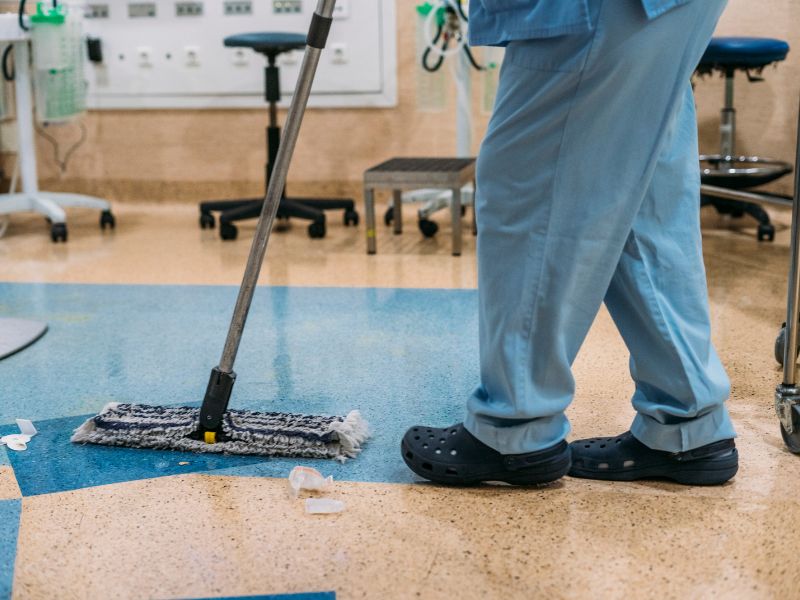
Maintaining a clean healthcare environment involves more than keeping facilities visually presentable. Proper environmental cleaning helps reduce contamination and supports efforts to prevent healthcare-associated infections (HAIs).
For Facility Managers, understanding the cleaning guidelines for healthcare facilities is essential when organizing maintenance operations, supervising cleaning teams, and establishing consistent hygiene practices.
This article summarizes key recommendations from the Centers for Disease Control and Prevention (CDC), providing practical guidance for hospitals, medical offices, clinics, and other healthcare environments.
Understanding healthcare cleaning and disinfection guidelines
Effective healthcare cleaning and disinfection begins with understanding two complementary processes.
Cleaning physically removes dirt, organic material, and many microorganisms from surfaces using water, detergents, and mechanical action. Disinfection uses appropriate chemical products to inactivate microorganisms remaining on surfaces.
According to the CDC, environmental cleaning in healthcare facilities should follow a risk-based approach. A waiting room, for example, presents different contamination risks than an examination room or patient care area.
Healthcare cleaning standards must therefore consider surface contact, patient vulnerability, contamination potential, and the activities performed in each space.
The CDC provides technical guidance for environmental cleaning, while the Occupational Safety and Health Administration (OSHA) addresses relevant worker safety considerations, including chemical exposure, bloodborne pathogens, and personal protective equipment.
Core cleaning guidelines every healthcare facility should follow
The CDC cleaning guidelines emphasize consistent procedures that reduce environmental contamination and support infection prevention and control.
Four operational practices deserve particular attention.
1. Prioritize high-touch surfaces

High-touch surfaces require special attention because frequent contact increases opportunities for contamination.
Door handles, light switches, handrails, countertops, reception desks, bed rails, and shared equipment surfaces should receive appropriate cleaning and disinfection based on their location and associated risks.
Facility Managers should identify these contact points when developing cleaning schedules.
2. Follow proper cleaning sequences
Cleaning should generally progress from cleaner areas toward dirtier areas and from higher surfaces toward lower surfaces.
Following these principles helps prevent contaminants from being transferred onto previously cleaned surfaces.
For example, staff should address less contaminated surfaces before moving to heavily soiled areas, following the facility’s established cleaning protocols.
3. Use appropriate disinfectants
Healthcare facilities should select EPA-registered disinfectants appropriate for their intended surfaces and target microorganisms.
Staff must follow product label instructions, including dilution requirements, application methods, compatibility, and contact time.
Contact time is particularly important because treated surfaces must remain visibly wet for the duration specified by the manufacturer to achieve the product’s labeled disinfection claims.
4. Prevent cross-contamination
Cleaning equipment and materials must be managed carefully to avoid transferring contamination between healthcare areas.
Separate cleaning supplies should be designated for higher-risk spaces when appropriate. Reusable materials require proper handling and reprocessing, while disposable supplies must be discarded according to established procedures.
Personnel should also use appropriate personal protective equipment (PPE) based on the task, product instructions, and exposure risks.
Cleaning requirements for different healthcare areas
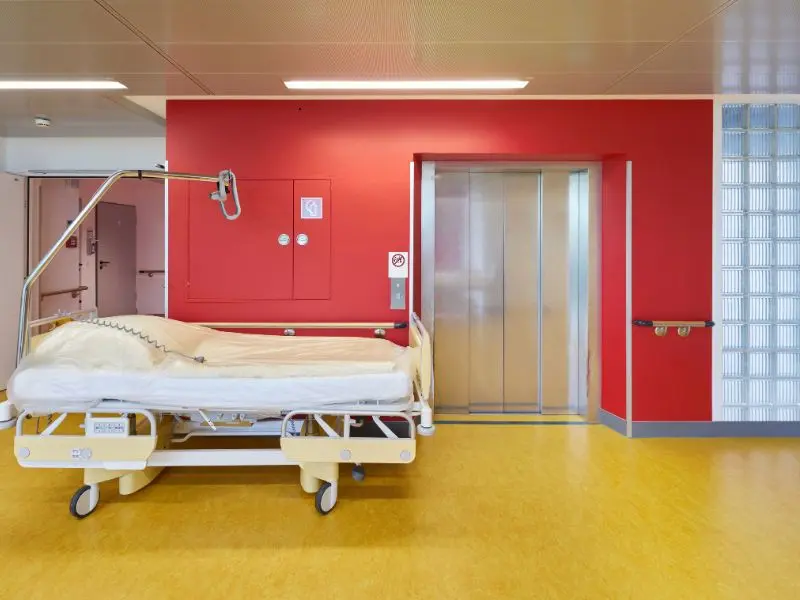
Different healthcare environments require different cleaning priorities. The level of patient contact, likelihood of contamination, and vulnerability of occupants should guide the selection of appropriate healthcare facility cleaning procedures.
The following table summarizes the main environmental cleaning priorities for common healthcare spaces.
| Healthcare area | Main cleaning priority |
| Waiting rooms | Frequently touched furniture, reception counters, door handles, and shared surfaces. |
| Examination rooms | Examination tables, patient-contact surfaces, countertops, and appropriate cleaning between patient visits. |
| Patient rooms | Bed rails, bedside furniture, frequently handled equipment, and surrounding environmental surfaces. |
| Restrooms | Toilets, sinks, faucets, dispensers, and other surfaces with elevated contamination potential. |
| High-risk clinical areas | More rigorous cleaning and disinfection protocols adapted to patient vulnerability and contamination risks. |
These priorities should be incorporated into facility-specific cleaning plans rather than treated as interchangeable procedures.
The CDC recommends assessing contamination probability, patient susceptibility, and surface exposure when determining appropriate cleaning methods and frequencies.
How often should healthcare facilities be cleaned?
Cleaning frequency should reflect the activities performed in each healthcare environment rather than follow a universal schedule.
The CDC distinguishes three important approaches:
- Routine cleaning: Regular environmental cleaning performed while healthcare areas remain operational, according to their established schedules.
- Terminal cleaning: More comprehensive cleaning and disinfection performed after patient discharge, transfer, or other circumstances requiring the preparation of a patient care space.
- Scheduled cleaning: Periodic attention to low-touch surfaces and areas not necessarily included in everyday procedures.
Facility Managers should establish frequencies according to contamination risks, patient vulnerability, facility usage, and applicable CDC recommendations.
The importance of trained healthcare cleaning professionals
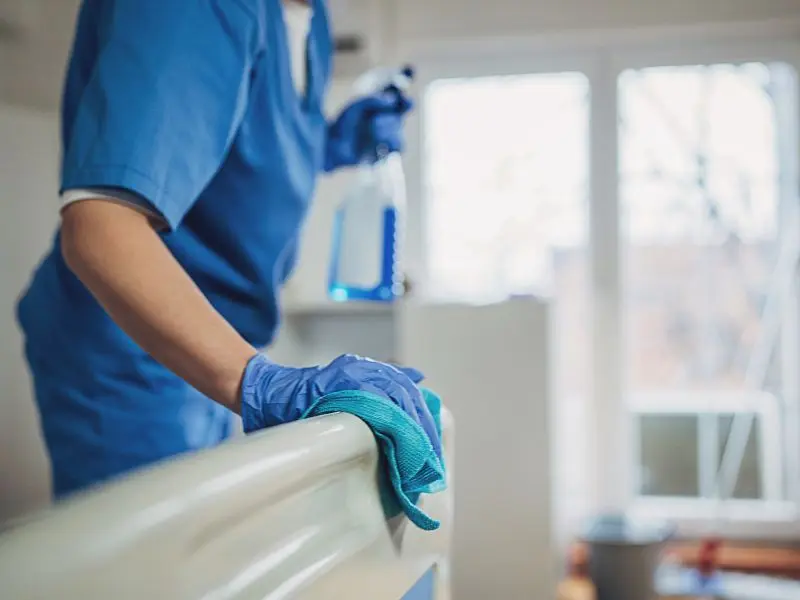
Effective environmental cleaning depends on more than having suitable equipment and disinfectants.
Professionals responsible for healthcare environments need training in cleaning sequences, chemical handling, PPE selection, and contamination prevention.
They must also understand how procedures change between administrative spaces, general patient areas, and higher-risk clinical environments.
Clear communication between cleaning supervisors, Facility Managers, and infection prevention personnel helps maintain consistency and address operational concerns.
Documented procedures, appropriate supervision, and periodic performance assessments further support reliable cleaning programs.
These practices help facilities maintain accountability while ensuring cleaning personnel understand their responsibilities within the broader infection prevention strategy.
Professional healthcare facility cleaning services in New Jersey
Healthcare organizations in New Jersey need cleaning programs that accommodate their operational requirements without unnecessarily disrupting patient care.
Working with an experienced commercial cleaning provider can help Facility Managers coordinate environmental maintenance, specialized cleaning tasks, and ongoing service supervision.
At BAP Janitorial, we understand the importance of attention to detail when maintaining healthcare environments, including hospitals, medical offices, outpatient clinics, dental practices, and wellness centers.
Our medical facility cleaning services are designed to support the individual cleaning needs of healthcare businesses throughout New Jersey. Contact us to discuss your facility’s requirements and request information about our professional healthcare cleaning solutions.